 English
 Español
 中文
中文News
Home / News / Industry News / With a recycling rate of less than 30% compared to over 60% overseas, why is China's copper tube industry missing out on the "circular economy dividend"?
“Producing one ton of copper tube using recycled copper saves nearly 2,000 yuan compared to using virgin copper, and also reduces carbon emissions by more than 80%, but we dare not use more than 25% recycled copper,” says Mr. Zhang, production director of a copper tube processing company in Zhejiang. His dilemma reflects the collective anxiety of China's copper tube industry on the path to a circular economy. As the world's largest consumer and producer of copper tube, China's utilization rate of recycled copper in the copper tube sector has long hovered between 28% and 30%, while in developed countries such as the United States and Germany, this proportion generally exceeds 60%, with some companies even reaching 80%. On one hand, there is an annual reserve of over 12 million tons of scrap copper resources; on the other hand, companies are hesitant to fully embrace the benefits of recycled copper. Why is China's copper tube industry struggling to capitalize on the "circular economy dividend" offered by recycled copper? Behind this lies multiple obstacles in resource recycling systems, quality standards, technological processes, and supporting policies, and it also holds the key to the industry's green transformation.
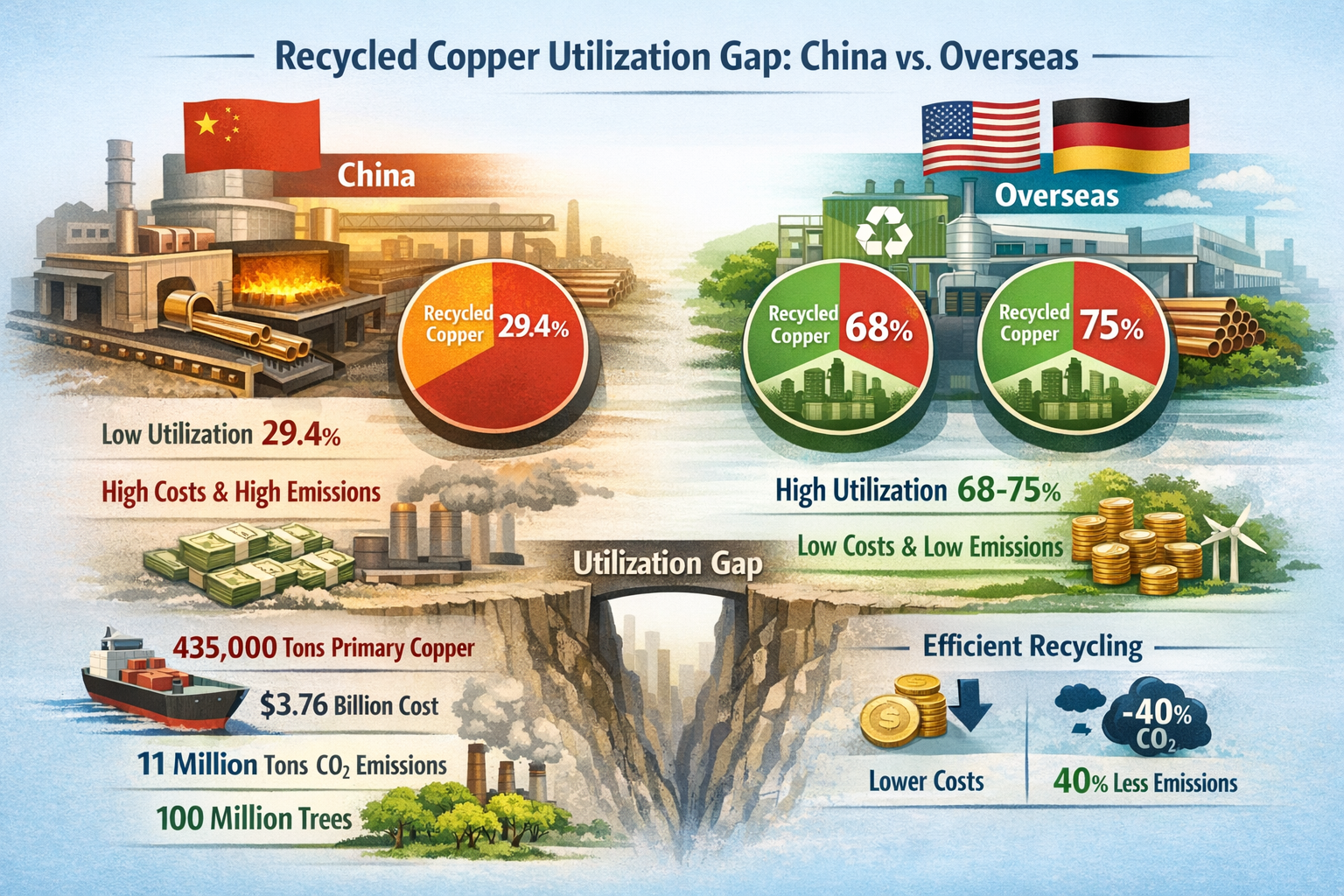
According to data from the Recycling Metals Branch of the China Nonferrous Metals Industry Association, China's recycled copper volume will reach 12.48 million tons in 2025, a year-on-year increase of 7.3%. The total amount of available recycled copper resources will exceed 10 million tons, theoretically meeting nearly 60% of the domestic copper tube industry's raw material needs. However, in reality, the utilization rate of recycled copper in domestic copper tube production in 2025 will only be 29.4%, a slight increase of 1.2 percentage points compared to 2024, a growth rate far lower than the growth rate of recycled copper resource supply.
In stark contrast, overseas companies demonstrate highly efficient recycling capabilities. Mueller Industries, a leading US copper tube manufacturer, boasts a recycled copper utilization rate of 68%. Their building and air conditioning copper tubes are primarily made from recycled copper, and through precise process optimization and composition control, the product quality is indistinguishable from products made from virgin copper. The German KME Group has further increased its recycled copper utilization rate to 75%, leveraging Europe's sophisticated scrap copper sorting and recycling system to achieve a closed-loop cycle of "scrap copper recycling—precise sorting—melting and refining—copper tube production." This results in a production cost per ton of copper tube that is 1800-2200 yuan lower than that of Chinese companies, and a carbon emission intensity that is only 40% of that of Chinese companies.
The disparity in the application ratio of recycled copper directly translates into a gap in cost and environmental competitiveness. Based on a projected domestic copper tube production of 1.423 million tons in 2025, increasing the utilization rate of recycled copper to 50% could reduce the reliance on imported primary copper by 435,000 tons, saving approximately US$3.76 billion in foreign exchange expenditures, while also reducing carbon emissions by over 11 million tons, equivalent to planting nearly 100 million trees. However, in reality, most domestic copper tube companies still adhere to a raw material structure of "primarily primary copper, supplemented by recycled copper," only adding small amounts of recycled copper to low-value conventional copper tube products, while high-end copper tube products rely entirely on primary copper.
(This image was generated by AI.)
|
Country/Company |
Recycled copper utilization rate |
Applications of recycled copper |
Cost advantage (vs. traditional Chinese copper processing methods) |
Percentage reduction in carbon emission intensity |
|
China (industry average) |
29.4% |
Standard copper tubes for air conditioning, ordinary copper tubes for building construction. |
5%-8% |
20%-25% |
|
Mueller Industries (USA) |
68% |
Building copper tubes, air conditioning copper tubes, industrial tube fittings |
15%-18% |
55%-60% |
|
KME Group (Germany) |
75% |
All types of copper tubes (including precision industrial copper tubes) |
18%-22% |
60%-65% |
|
Furukawa Electric (Japan) |
62% |
Copper tube for home appliances, copper tube for automobiles |
14%-16% |
50%-55% |
Table 1: Comparison of Recycled Copper Application and Benefits in Chinese and Foreign Copper Tube Companies
The Chinese copper tube industry is not unwilling to embrace recycled copper, but it is constrained by multiple factors, including the recycling system, quality control, technological processes, and policy environment, making it difficult to break through the dilemma of "low-proportion application and low-quality suitability." In-depth research reveals that four core obstacles are the key factors hindering the large-scale application of recycled copper.
Unlike the standardized system in Europe, which is characterized by "government leadership + corporate participation + classified recycling," the Chinese scrap copper recycling market presents a fragmented and disorganized landscape. Currently, individual businesses account for over 60% of domestic scrap copper recyclers, lacking professional sorting and classification capabilities. They mostly employ a "mixed recycling and simple screening" model, resulting in high impurity content and significant compositional variations in the recycled copper. According to data from Shanghai Metals Market (SMM), the impurity content in domestically recycled scrap copper is generally between 0.5% and 1.2%, while in Europe, standardized recycling processes can keep impurity levels below 0.1%, with compositional fluctuations only one-third of those in China.
“We tried to increase the proportion of recycled copper, but the recycled scrap copper we received often had excessive iron content one day and unacceptable lead content the next, leading to significant fluctuations in the mechanical and thermal properties of the finished copper tubes, resulting in frequent customer complaints,” said Engineer Zhang. He added that to ensure stable product quality, the company had to reduce the amount of recycled copper used and invest in additional purification processes, which negated the cost advantages of using recycled copper. Furthermore, irregularities in the taxation of scrap copper recycling made it difficult for the company to obtain compliant invoices, further hindering their willingness to purchase recycled copper.
Currently, domestic copper tube quality standards are mostly based on virgin copper, and there are differences between China and other countries regarding the permissible range of recycled copper composition and impurity control requirements. For example, the requirements for oxygen content and impurity content in copper tubes specified in the "Seamless Copper and Copper Alloy Tubes for Air Conditioning and Refrigeration Equipment" (GB/T 17791-2021) are more suited to virgin copper production processes. Even after purification, recycled copper is difficult to consistently meet the standard requirements for high-end products. In contrast, countries such as Germany and the United States have developed specific standards for recycled copper tubes, clearly defining the compositional control range and process adaptation requirements for recycled copper, providing a basis for its application in high-end fields.
More importantly, downstream high-end sectors have a biased perception of recycled copper tubes. Industries such as semiconductors, new energy vehicles, and biomedicine generally prefer virgin copper products, believing that recycled copper has problems such as "unstable quality and high risk of impurity residue." Even if some recycled copper tube products meet equivalent quality standards, it is difficult for them to enter high-end supply chains. This cognitive bias, coupled with a lack of relevant standards, further restricts the application of recycled copper.
To meet the production requirements for copper tubes, recycled copper needs to undergo precise purification, composition control, and process adaptation. However, domestic companies lag significantly behind their overseas counterparts in this area. Overseas companies commonly employ an integrated technology of "vacuum induction melting + continuous casting + online composition detection," which allows for real-time control of recycled copper composition, efficient removal of impurities, and achieves a purity of over 99.993% for the purified recycled copper, comparable to virgin copper. The yield rate can be maintained at over 92%.
Most domestic enterprises still use traditional flame smelting and manual sorting and purification technologies. This not only results in low purification efficiency but also makes it difficult to precisely control the composition, leading to a general purity of recycled copper below 99.97% and a yield of only 82%-85%, which is 5-8 percentage points lower than that of primary copper production. "An imported recycled copper purification production line costs tens of millions of yuan, which is simply unaffordable for small and medium-sized enterprises, while the purification accuracy and stability of domestically produced equipment do not meet the requirements," said a负责人 (responsible person) from a copper processing equipment company. This gap in technology and equipment makes it difficult for domestic enterprises to achieve efficient utilization of recycled copper, leading to a vicious cycle of "high purification costs and low yield."
Although the government is actively promoting the development of a circular economy, there is still a lack of specific policies targeting the application of recycled copper in the copper tube industry. Currently, most relevant policies focus on macro-level guidance and lack concrete incentive measures and regulatory mechanisms. For example, tax incentives for recycled copper processing enterprises are insufficient, with little difference in tax burden compared to primary copper processing enterprises; funding for the recycled copper recovery system is fragmented, making it difficult to achieve economies of scale; and there is a lack of incentive policies for downstream companies to use recycled copper products, resulting in insufficient market demand.
Furthermore, the incentive effect of carbon market policies on the application of recycled copper has not yet been fully realized. Currently, while carbon emissions accounting for copper processing enterprises is included in China's domestic carbon market, the carbon emission reductions achieved through the use of recycled copper are difficult to translate into actual profits. Therefore, companies lack the motivation to reduce carbon costs by increasing the utilization rate of recycled copper. In contrast, Europe, through mechanisms such as carbon tariffs and carbon quota trading, allows the environmental benefits of recycled copper applications to be directly converted into economic benefits, greatly stimulating corporate enthusiasm.
To overcome the challenges in the application of recycled copper, the Chinese copper tube industry cannot rely solely on individual companies. Instead, it needs a coordinated effort across four dimensions: recycling systems, quality standards, technological processes, and policy support. A comprehensive, end-to-end support system must be built to ensure that recycled copper truly becomes a new engine for cost reduction, efficiency improvement, and green transformation in the industry. The exploratory practices of some companies and local governments provide valuable pathways for the industry to follow.
The government and leading enterprises are working together to promote the intensive and standardized development of the scrap copper recycling market. On the one hand, local governments can introduce policies to support leading enterprises in building regional scrap copper recycling and sorting centers, equipped with professional sorting equipment and testing instruments, to achieve classified recycling, accurate testing, and standardized packaging of scrap copper. On the other hand, copper tube manufacturers are encouraged to establish long-term cooperative relationships with recycling companies and sign targeted recycling agreements to control the quality of recycled copper from the source.
Zhejiang Hailiang Co., Ltd.'s approach is quite representative. The company has collaborated with local governments and leading recycling companies to establish a closed-loop system encompassing "waste copper recycling—sorting and testing—centralized purification—targeted supply." They have established five standardized recycling and sorting centers nationwide, equipped with spectroscopic testing equipment to accurately sort and analyze the composition of recycled copper, ensuring that the impurity content of recycled copper is controlled to below 0.2%. Through this system, Hailiang Co., Ltd. has increased its recycled copper utilization rate to 42%, 12.6 percentage points higher than the industry average, resulting in significant cost advantages.
Industry associations should take the lead in formulating specific standards for recycled copper tubes, optimizing quality indicator requirements based on the compositional characteristics of recycled copper, and clarifying the application scope and process compatibility standards for recycled copper in different fields. At the same time, they should strengthen standard promotion and market guidance, organize enterprises to carry out recycled copper tube product certification, and eliminate cognitive biases among downstream enterprises.
Currently, the China Nonferrous Metals Processing Industry Association has initiated the development of a group standard for "Recycled Copper Seamless Tubes." This standard aims to establish specific requirements for the composition control, impurity content, and mechanical properties of recycled copper, while also clarifying the application specifications for recycled copper tubes in fields such as air conditioning, construction, and automotive industries. The introduction of this standard is expected to provide a basis for the large-scale application of recycled copper tubes and break down application barriers in high-end sectors.
Companies should increase investment in research and development, focusing on technologies for recycled copper purification, composition control, and process adaptation, in order to overcome technological bottlenecks. On the one hand, they should strengthen cooperation with universities and research institutions to develop low-cost, high-efficiency recycled copper purification technologies, reducing impurity content and improving compositional stability. On the other hand, they should optimize the copper tube production process to adapt to the characteristics of recycled copper raw materials, improving yield and quality consistency.
In terms of technological innovation, Anhui Chujiang Technology has achieved significant breakthroughs. The company's integrated "recycled copper vacuum refining + continuous extrusion molding" technology can increase the purity of recycled copper to over 99.99%, control impurity content to below 0.08%, and improve the yield rate to over 90%. Leveraging this technology, the company's recycled copper air conditioning copper tubes have entered the supply chains of leading companies such as Gree and Midea, achieving a recycled copper utilization rate of 45% and reducing costs by 12% compared to traditional virgin copper processes.
The government should introduce precise policy measures to create a favorable environment for the application of recycled copper. Firstly, it should increase tax incentives, implementing a value-added tax refund policy for recycled copper processing enterprises and simplifying tax invoice management in the recycling process to address compliance difficulties for businesses; secondly, it should establish special subsidies for recycled copper applications, providing financial support to enterprises that achieve a certain proportion of recycled copper utilization and encouraging technological upgrades; thirdly, it should improve carbon market policies, incorporating carbon emission reductions from recycled copper applications into the carbon quota trading system, allowing enterprises to obtain additional revenue; and fourthly, it should strengthen supervision, regulate the order of the scrap copper recycling market, combat the circulation of substandard recycled copper, and ensure market fairness.
Furthermore, drawing on European experience, China could promote a policy of "mandatory recycled copper content" in copper tube products, specifically targeting sectors such as construction and home appliances. This would mandate a minimum percentage of recycled copper in these products, thereby compelling companies to accelerate their transformation. According to Yong'an Research, with adequate policy support, the utilization rate of recycled copper in China's copper tube industry is expected to exceed 50% by 2030, saving over 600,000 tons of primary copper imports annually and reducing carbon emissions by over 15 million tons. This would significantly enhance the industry's competitiveness.
The current situation, where the utilization rate of recycled copper is less than 30%, is both a weakness of China's copper tube industry and a huge potential for future transformation. Amidst the "dual carbon" goals and the global trend of green transformation in manufacturing, recycled copper is no longer just a "low-cost alternative raw material," but a core tool for companies to reduce costs, increase efficiency, and enhance their environmental competitiveness.
To overcome the challenges in the application of recycled copper in China's copper tube industry, it is necessary to break away from the old pattern of "fragmented recycling, low-standard adaptation, and weak technological support," and build a new system of "standardized recycling, precise purification, standardized application, and comprehensive guarantees." Only in this way can China truly seize the "circular economy dividends" brought by recycled copper, occupy a favorable position in the restructuring of the global industrial chain, achieve a transformation from "scale expansion" to "green and efficient development," and embark on a path of high-quality development.
Large copper tube with an outer diameter of 28-54mm possess excellent pressure resistance and a stable structure, specifically designed for high-load,...
See Details
Corrosion-resistant phosphorus deoxidized copper tube (grades TP1/TP2 (more commonly used)) are manufactured using a phosphorus deoxidation process, w...
See Details
Standard refrigeration copper tube with an outer diameter of 12-28mm is made of high-quality TP2 copper (C12200/DHP), specifically designed for HVAC s...
See Details
Ultra-fine copper tube with an outer diameter of <5mm are high-precision, high-value-added copper tube products. With an outer diameter less than 5...
See Details
Small copper tube with an outer diameter of 5-12mm are copper tubing products with excellent flexibility, easy processing, and high conductivity. They...
See Details
Conventional silver-copper alloy typically contain 0.06%-0.12% silver. The addition of silver significantly improves the softening temperature and cre...
See Details
 Tangpu Industrial Zone, Shangyu District, Shaoxing City, Zhejiang Province, China
 +86-13567501345
© Zhejiang Jingliang Copper-Tube Products Co., Ltd All rights reserved.

