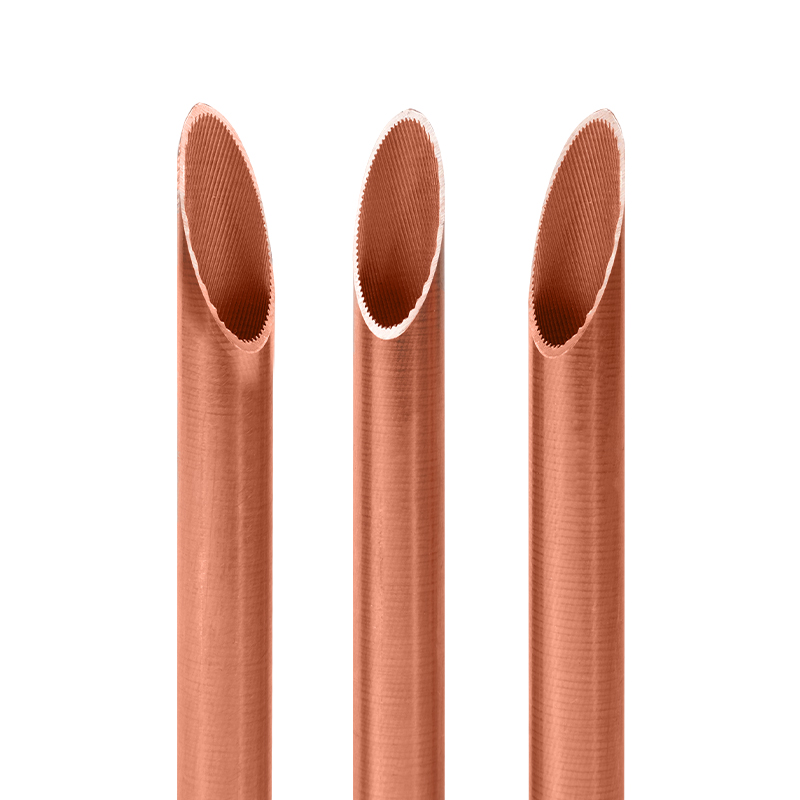
An inner grooved tube is a heat transfer tube whose interior wall features a series of helical or axial micro-grooves that dramatically increase surface area and turbulence, resulting in heat transfer coefficients 1.5 to 3 times higher than those of smooth-bore tubes. This enhancement is achieved without increasing the outer diameter, making inner grooved tubes the preferred choice for compact, high-efficiency heat exchangers in air conditioning, refrigeration, and industrial thermal systems.
The grooves are typically machined or rolled into copper, aluminum, or stainless steel tubing during manufacturing. Groove geometry—including helix angle, groove depth, groove count, and fin tip shape—is engineered to maximize fluid contact and minimize pressure drop simultaneously.
The performance gain from inner grooves comes from two complementary mechanisms:
In two-phase flow applications such as refrigerant evaporation or condensation, grooves also promote nucleate boiling and enhance film drainage, reducing wall superheat requirements. Laboratory measurements on copper inner grooved tubes with 60 grooves at a 18° helix angle show condensation heat transfer coefficients exceeding 12,000 W/m²·K, compared to roughly 6,000 W/m²·K for a smooth tube under identical conditions.
The thermal and hydraulic performance of an inner grooved tube is governed by its groove geometry. Understanding these parameters helps engineers select the right tube for each application.
Groove depth typically ranges from 0.10 mm to 0.25 mm in commercial refrigeration tubes. Deeper grooves increase surface area and turbulence but also raise the friction factor. For R-410A and R-32 systems, a depth of 0.15–0.18 mm is widely regarded as the optimum trade-off.
The helix angle describes how steeply the grooves spiral along the tube axis. Angles between 15° and 25° are most common. Higher angles intensify swirl and heat transfer, but increase pressure drop more rapidly, so low-pressure-drop circuits favor angles near 15°.
Groove count in standard copper tubes ranges from 40 to 80. A higher count subdivides the surface into narrower fins, increasing area but reducing per-groove flow depth. Tubes with 60–70 grooves balance manufacturing feasibility with thermal performance for 7 mm OD refrigerant tubes.
The apex angle of the fin between grooves influences condensate shedding. Narrow tip angles (30–40°) improve drainage in condensers; wider angles (50–60°) improve nucleation in evaporators.
| Parameter | Typical Range | Effect on Performance |
|---|---|---|
| Groove depth (e) | 0.10–0.25 mm | Higher → more area & turbulence; higher ΔP |
| Helix angle (β) | 15°–25° | Higher → stronger swirl; penalty in pressure drop |
| Number of grooves (N) | 40–80 | More → finer fins; greater area |
| Fin tip angle (γ) | 30°–60° | Narrow → better condensate drainage |
| Wall thickness | 0.22–0.35 mm | Thinner → lower weight; must meet burst pressure |
Material selection affects thermal conductivity, corrosion resistance, formability, and cost. The three dominant materials are:
Copper's thermal conductivity of 385–400 W/m·K makes it the standard material for HVAC and refrigeration inner grooved tubes. Its high ductility allows groove depths down to 0.10 mm to be formed without cracking, and it is compatible with all common refrigerants including HFCs, HFOs, and natural refrigerants such as R-290 (propane). Copper inner grooved tubes account for over 70% of global heat exchanger tube volume.
Aluminum inner grooved tubes offer a 65% weight reduction versus copper equivalents and are increasingly used in automotive heat exchangers and microchannel-type coils. Thermal conductivity is lower at 150–205 W/m·K, so groove geometry must be optimized more aggressively to compensate. Aluminum tubes are also cost-competitive, with raw material costs roughly 40–50% below copper on a per-kilogram basis.
Despite its low conductivity (14–17 W/m·K), stainless steel inner grooved tubes are specified in corrosive or high-pressure environments—desalination plants, pharmaceutical heat exchangers, and chemical process equipment—where copper would corrode or fail. Groove depth is constrained by formability, so stainless grooved tubes rely more on turbulence than on area extension for performance gain.
Inner grooved tubes are embedded in virtually every high-performance heat exchanger where compact size and efficiency matter:
The case for using inner grooved tubes becomes clearest when comparing them to smooth-bore tubes of the same diameter under identical operating conditions.
| Metric | Smooth Tube | Inner Grooved Tube | Improvement |
|---|---|---|---|
| Heat transfer coefficient (W/m²·K) | ~4,500 | ~9,800 | +118% |
| Internal surface area (cm²/m) | ~22 | ~38 | +73% |
| Pressure drop (kPa/m) | ~0.8 | ~1.3 | +63% (managed) |
| Coil volume for same duty | Baseline | −25 to −35% | Significant size reduction |
| Refrigerant charge | Baseline | −15 to −25% | Lower charge & environmental impact |
The pressure drop penalty—while real—is typically offset by the size and charge reductions. System designers use circuit-splitting and optimized flow distributors to keep the incremental pressure drop from becoming a system-level efficiency penalty.
Commercial inner grooved tubes are produced through a continuous cold-forming process that preserves tube straightness and dimensional accuracy. The primary method is:
With dozens of groove geometries available, selecting the right tube requires matching geometry to application:
Prioritize tubes with deeper grooves (0.18–0.22 mm) and higher helix angles (20–25°) to maximize nucleate boiling and wet-wall contact. Fin tip angles of 50–60° improve liquid film retention and nucleation site density.
Specify narrower fin tip angles (30–40°) to shed condensate rapidly and expose fresh tube wall. Groove depth can be slightly lower (0.12–0.16 mm) since condensation heat transfer is less sensitive to depth than evaporation.
Use high-groove-count tubes (60–80 grooves) in smaller diameters (5–7 mm OD) to maintain high heat transfer at lower refrigerant mass, reducing flammable charge inventories. Copper wall thickness should meet EN 12735 or ASTM B743 burst requirements for the maximum system pressure.
Select tubes rated to at least 14 MPa design pressure with wall thicknesses of 0.5–0.8 mm. CO₂'s high operating pressure limits groove depth to 0.08–0.12 mm, but its intrinsically high heat transfer coefficient compensates effectively.
Inner grooved tubes for HVAC&R must conform to international standards that govern dimensional tolerances, mechanical properties, and pressure ratings:
All standards require 100% air-under-water or eddy-current leak testing and specify maximum allowable eccentricity to prevent localized thin spots that could fail under cyclic refrigerant pressure.
The inner grooved tube is not a static product. Active research and market pressure are driving measurable improvements:
The global inner grooved tube market, valued at approximately USD 3.2 billion in 2024, is projected to grow at a CAGR of 5.8% through 2030, driven by expanding HVAC markets in South and Southeast Asia, increasing refrigerant regulation prompting coil redesigns, and the electrification of transport and industrial heating.
Content
The inner grooved tube incorporates precision-engineered grooves or ridges along its interior surface as a specialized heat exchanger component. These...
See Details
Copper Tube is made of high-purity copper material with a copper content of not less than 99.9%. The main material codes are T11050 and C12200(DHP), a...
See Details
H65 (C27000) Brass Tube is a brass alloy with approximately 65% copper and 35% zinc content. Its properties fall between those of H68 and H62 brass ...
See Details
H63 (T27300) Brass Tube is a high-performance brass alloy tube with a copper content of 63% and a zinc content of 37%. Its excellent mechanical proper...
See Details
H62 (T27600) Brass Tube is a brass alloy with a copper content of 62% and a zinc content of 38%. Due to its balanced performance in terms of strength ...
See Details
Thick-walled copper tubes are also called seamless thick-walled copper tubes. Thick-walled copper tubes are manufactured by a hot extrusion process, w...
See Details