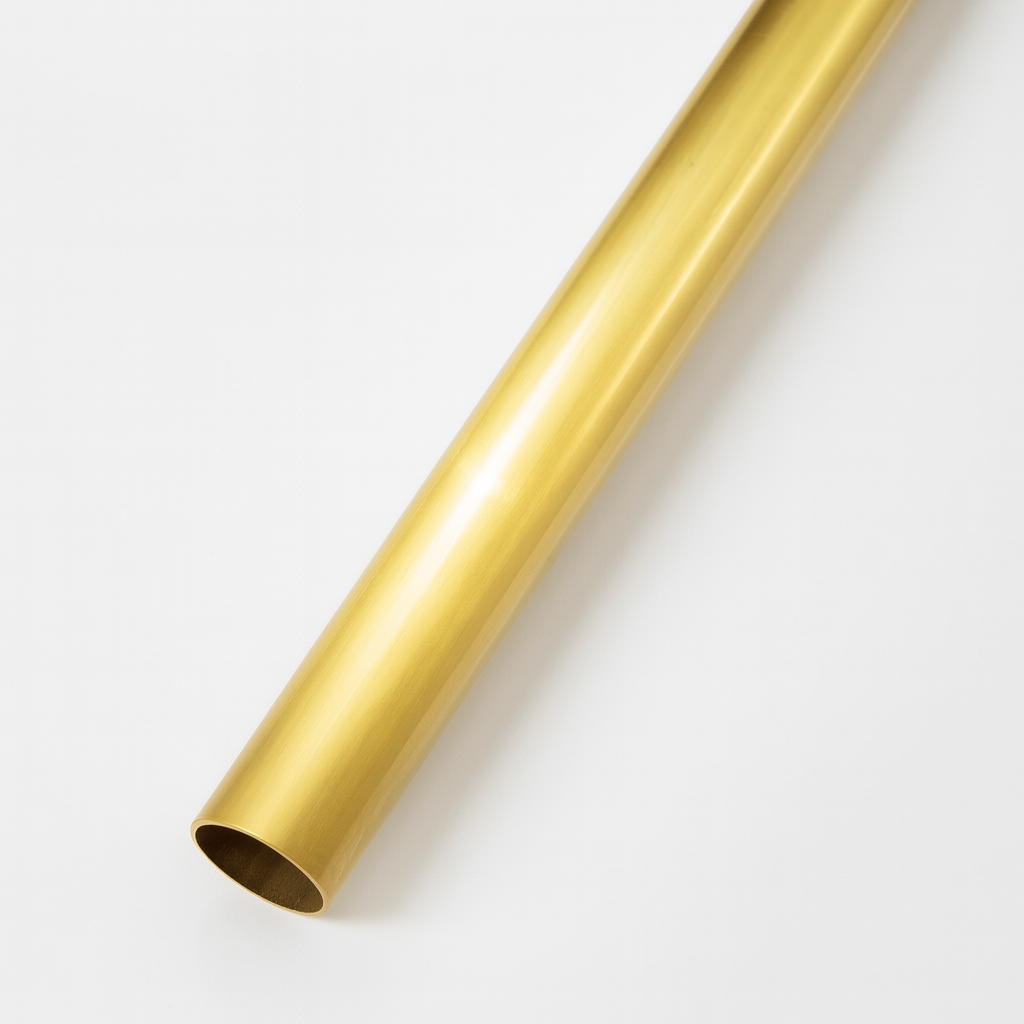
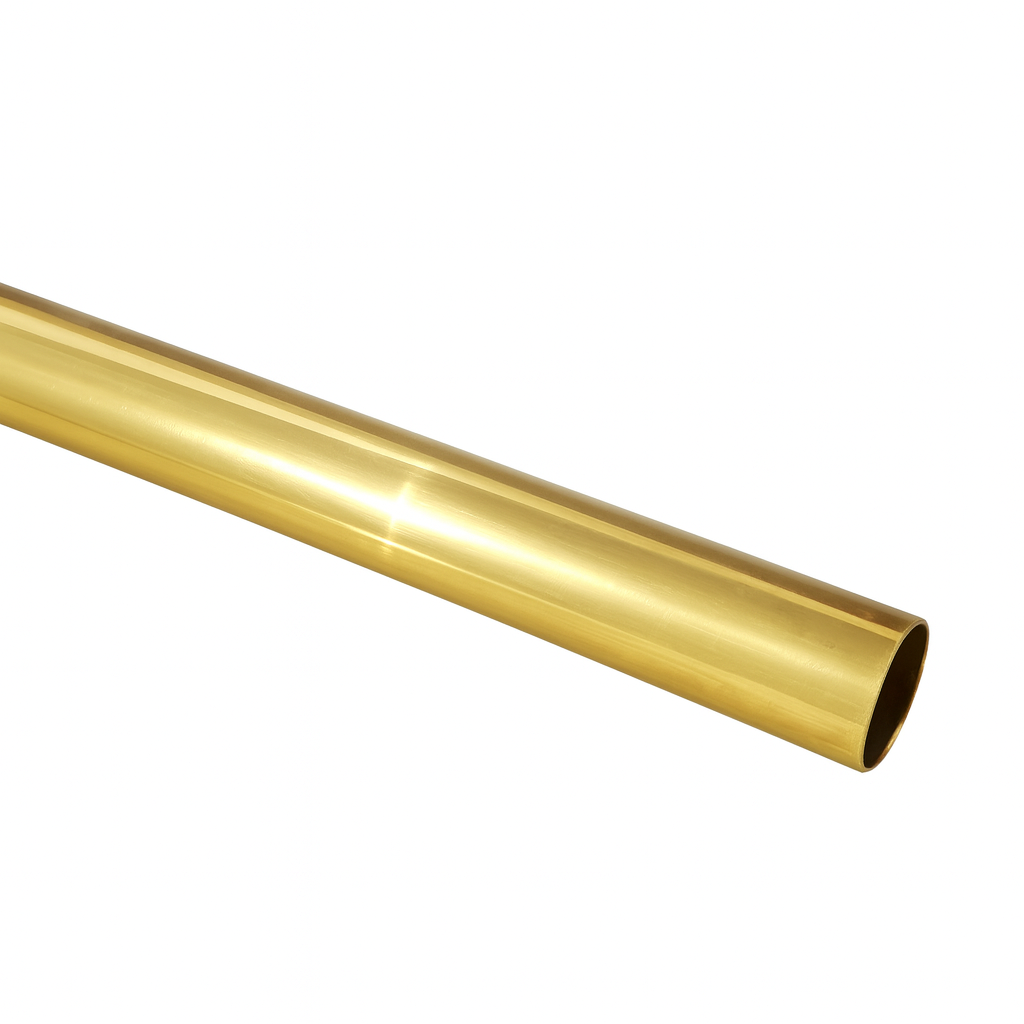
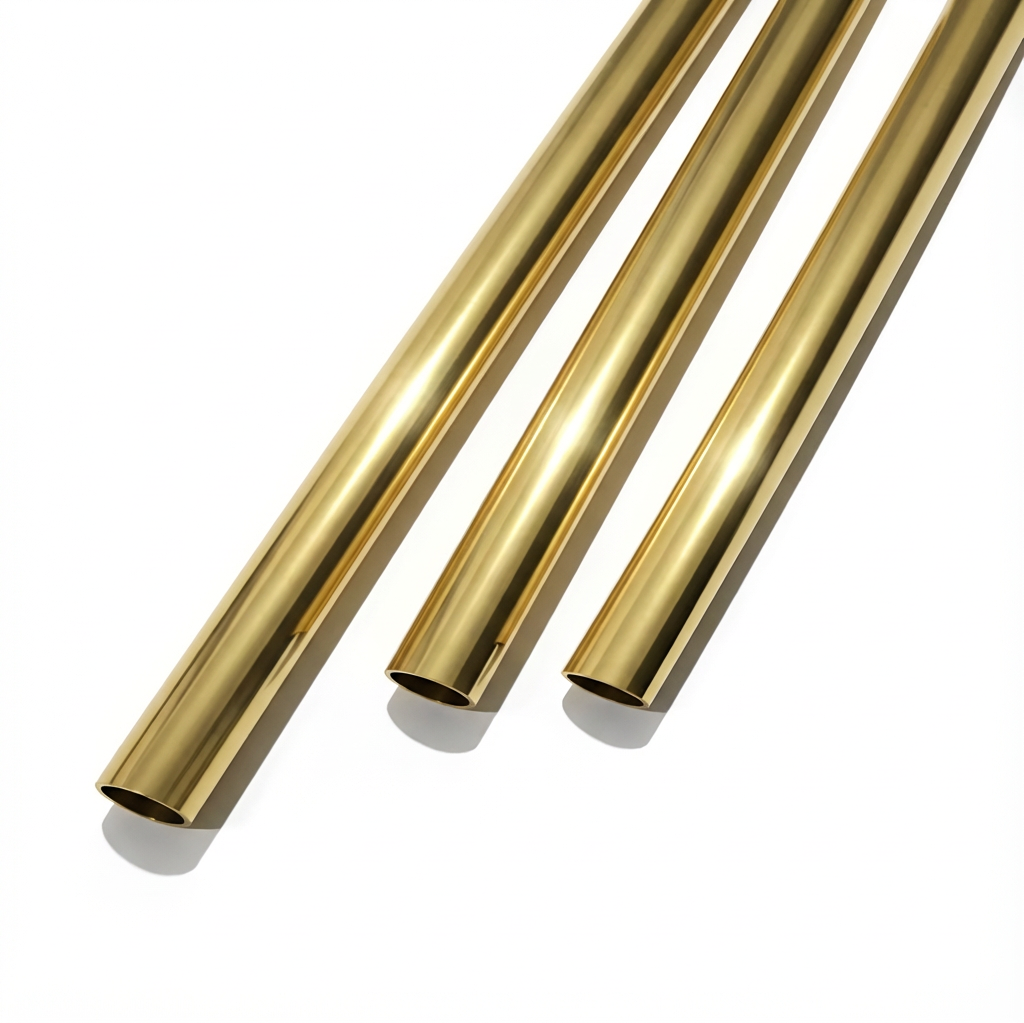
The most reliable way to bend brass tubing without kinking is to use an internal support — either a spring mandrel, sand fill, or a proper tube bender — combined with a slow, even bending motion. Without internal support, the tube wall buckles inward on the compression side, creating irreversible kinks. This guide covers every proven method, the physics behind kinking, and when to use each technique, whether you are a hobbyist or sourcing bulk bends from a brass tube factory.
When you bend a tube, the outer wall stretches under tension while the inner wall is compressed. For solid rod this is not a problem, but a hollow tube has no material inside to resist the compressive force. Once the wall stress exceeds the material's yield strength, the inner surface buckles, forming the crease known as a kink.
Brass (typically C260 cartridge brass or C330 free-machining brass) has a tensile strength of roughly 300–500 MPa depending on temper, and a relatively low work-hardening rate compared with stainless steel. That makes it easier to bend but also means thin-wall tubes reach their buckling threshold quickly.
Three factors determine whether a bend kinks:
Annealing reduces internal stress and increases ductility, giving the brass more "give" before it buckles. It is the single most impactful preparation step, especially for tubing supplied in the hard or half-hard temper from a brass tube factory.
After annealing, thin-wall brass (D/t ≥ 15) can typically achieve center-line radii as tight as 1.5× OD with proper tooling, compared with roughly 3× OD for un-annealed tubing.
A tightly wound coil spring, sized to slide snugly inside the tube, supports the wall during bending. This is the most accessible method for hobbyists and is available for tube sizes from 3 mm to 35 mm OD.
Best for: Small-diameter brass tube (under 15 mm), gentle curves (bend angle up to 90°), low-volume work.
Dry, fine-grained sand (play sand works; dry it in an oven at 120 °C for 30 minutes) packed tightly inside the tube creates an incompressible internal mass that distributes bending stress across the entire wall cross-section.
Best for: Larger diameters (15–50 mm), irregular or compound curves, situations where spring mandrels are not available.
A rotary (mandrel) bender clamps the tube against a grooved forming die and rolls it around a calibrated radius wheel. Quality benders include a counter-die (pressure die) that prevents ovalization. This method produces consistent, repeatable bends within ±1° and is the standard in any professional brass tube factory setting.
Hand-operated ratchet benders cost roughly $40–$150 USD for common sizes. Hydraulic or CNC rotary benders used in factory environments can produce multi-radius bends in a single programmed sequence with tolerances under 0.5 mm on center-line radius.
Best for: Precision work, repeated bends to the same angle, medium to large production runs.
Cerrobend (a bismuth-based alloy) melts at approximately 70 °C (158 °F) — below the boiling point of water. You pour it liquid into the tube, let it solidify, bend the tube, then melt the alloy out in boiling water or a hot oven. It provides near-perfect internal support.
This method is favored in aerospace and precision instrument manufacturing where wall deformation must be kept below 2% of nominal OD. The alloy is reusable and non-toxic in solid form, though fumes during melting require ventilation.
Best for: Thin-wall tubes, very tight radii, complex 3D bends, high-precision applications.
For gentle curves (center-line radius ≥ 3× OD) in thick-wall brass tube, simply annealing the tube and bending it slowly over a wooden or metal former — a pipe, curved jig, or radiused block — can be sufficient without any fill.
Keep hand pressure distributed over at least 100 mm (4 in) of tube length, not concentrated at one point. Avoid using a sharp-edged block as the former; the bending radius of the former must match or exceed the desired tube bend radius.
Best for: Thick-wall, small D/t ratio tube; large-radius decorative or architectural bends.
| Method | Min. Radius (× OD) | Ideal Tube Size | Cost / Skill | Best Application |
|---|---|---|---|---|
| Spring Mandrel | 2× | 3–35 mm OD | Low / Low | DIY plumbing, models |
| Sand Fill | 2–3× | 15–50 mm OD | Very Low / Low | Large-diameter decorative |
| Rotary Bender | 1.5× | 6–100 mm OD | Medium / Medium | HVAC, plumbing, industrial |
| Cerrobend Fill | 1× | Any | High / High | Aerospace, instruments |
| Heat + Former | 3× | Any thick-wall | Very Low / Low | Architectural, gentle curves |
Brass, like all metals, springs back elastically after bending. For annealed C260 brass, springback is typically 2°–5° per 90° of bend; for half-hard brass it can reach 8°–12°. This means you must overbend intentionally to hit your target angle.
Practical approach: make a test bend on a scrap length, measure the springback, then add that correction to all subsequent bends. For a rotary bender, set the stop 5° past the desired angle as a starting point for annealed brass and adjust from there.
CNC benders in brass tube factory production environments store springback correction values in their programming — often as a material-and-radius lookup table — so every bend in a batch lands within ±0.5°.
A brass tube factory producing pre-bent components for OEM customers uses a fundamentally different approach from the DIY workshop. Key differences:
When ordering pre-bent brass tube from a factory, specifying the center-line radius (CLR), bend angle, and acceptable ovality (typically ≤ 3% of OD for pressure applications) gives the manufacturer the information needed to select the right tooling and process.
Not all brass alloys bend equally well. The table below shows the most common alloys used in bending applications.
| Alloy (UNS) | Common Name | Zinc % | Bend Formability | Notes |
|---|---|---|---|---|
| C260 | Cartridge Brass | 30% | Excellent | Best all-round choice for bending |
| C220 | Commercial Bronze | 10% | Excellent | More copper-rich; very ductile |
| C330 | Low-Lead Brass | 35% | Good | Lead aids machinability but reduces ductility slightly |
| C360 | Free-Machining Brass | 35% | Poor | High lead content; avoid bending — use for machined fittings |
When specifying tubing from a brass tube factory for a bending application, always request C260 in O60 (annealed) temper unless your application specifically requires a harder temper for pressure or structural reasons.
Even with best practices, minor issues can appear. Here is how to assess and address them:
For pressure-service tubing (refrigeration lines, hydraulics), any bend that will carry fluid or gas should be leak-tested at 1.5× working pressure before installation — a basic industry standard regardless of how clean the bend looks visually.
Content
Brass is an alloy of copper and zinc. It has good processing and mechanical properties, so it is widely used in the manufacture of tubes.Because it ha...
See Details
The copper evaporator tube adopts a unique fin design, and the external fins are equipped with specially designed interconnected channels, so that eac...
See Details
H62 (T27600) Brass Tube is a brass alloy with a copper content of 62% and a zinc content of 38%. Due to its balanced performance in terms of strength ...
See Details
H63 (T27300) Brass Tube is a high-performance brass alloy tube with a copper content of 63% and a zinc content of 37%. Its excellent mechanical proper...
See Details
H65 (C27000) Brass Tube is a brass alloy with approximately 65% copper and 35% zinc content. Its properties fall between those of H68 and H62 brass ...
See Details
H68 (T26300) Brass Tube is a brass alloy with approximately 68% copper and 32% zinc. It stands out among many brass alloys due to its excellent overal...
See Details