 English
 Español
 中文
中文News
Home / News / Industry News / Copper Tube Trade Restructuring: How Geopolitics Reshapes Global Supply Chains and Regional Competitiveness
Subtitle: When the U.S. imposed 50% tariffs on copper tubes triggered a global trade chain restructuring, how did production capacity in Southeast Asia and Mexico surge by 46.3% within a year? This policy-driven supply chain migration is redrawing the global value distribution map for copper tubes.
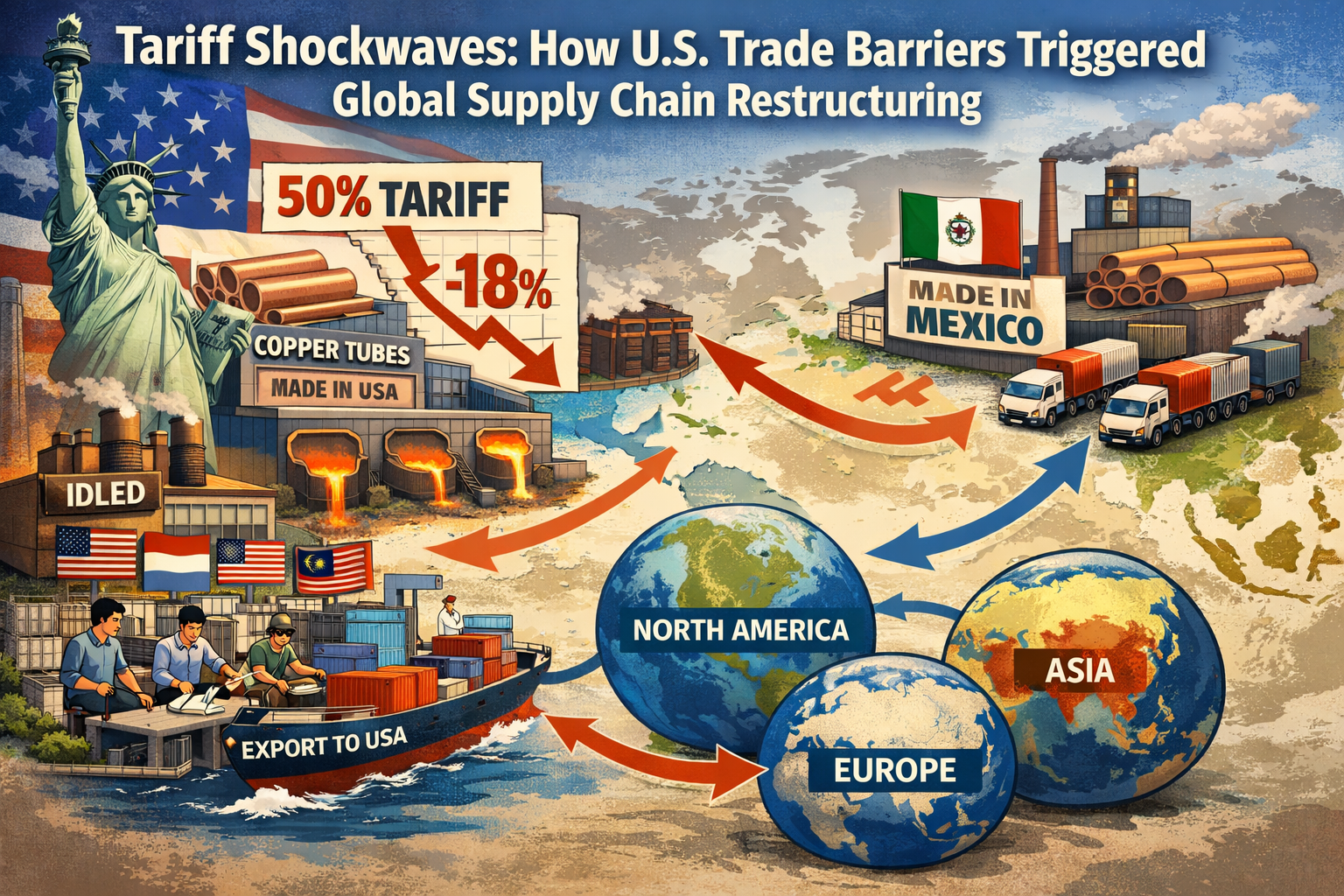
In August 2025, the U.S. officially implemented a 50% tariff on copper tubes and other semi-finished products, causing New York copper prices to plummet by 18% in a single day, the largest drop since 1968 . This policy specifically targeted intermediate products like copper tubes and wires, while exempting raw materials such as refined copper, revealing a strategic intent to protect domestic downstream manufacturing . However, structural weaknesses in the U.S. copper industry have led to counterproductive effects: with only 3 active smelters domestically (one of which is idled), annual refined copper production capacity is about 890,000 tons, insufficient to meet the 1.6 million tons annual demand, resulting in 45% of consumption relying on imports.
The tariff policy directly triggered a reconstruction of global trade flows. Southeast Asian countries like Thailand, Vietnam, and Malaysia, leveraging labor cost advantages, absorbed transferred Chinese copper tube production capacity, increasing exports to the U.S. by 37% within three months after the policy took effect . A more significant change occurred within North America—Mexico, utilizing the rules of origin advantages under the USMCA, accelerated its copper tube production layout, increasing its share of U.S. imports to 63.77%, making it the biggest beneficiary . This regional supply chain restructuring is shifting global copper tube trade from "globalization" to "regionalization," accelerating the formation of three major spheres: North America, Asia, and Europe.
(This image was generated by AI.)
Table: Comparison of Copper Tube Trade Flows to the U.S. Before and After the Tariff Policy (2025)
|
Region |
Pre-Policy Share of U.S. Imports |
Post-Policy Share of U.S. Imports |
Change |
|
China |
28.5% |
4.2% |
85% decrease |
|
Mexico |
42.1% |
63.8% |
52% increase |
|
Southeast Asia |
15.3% |
27.6% |
80% increase |
|
Canada |
30.9% |
38.5% |
25% increase |
The relocation of global copper tube production capacity exhibits distinct geographical characteristics. Southeast Asia, leveraging low labor costs and lenient environmental policies, has attracted large-scale investment from Chinese copper enterprises . Jiangxi Naile Copper's project in Thailand, with an annual capacity of 80,000 tons of precision copper tubes, increased local production capacity by 46.3%, with costs 30% lower than domestic production in China . Crucially, Thailand enjoys tariff preferences for exports to Europe and the U.S., allowing products to effectively circumvent trade barriers while maintaining price competitiveness.
Mexico has become the biggest winner thanks to its geographical proximity and USMCA rules of origin. Germany's Wieland Group expanded its copper tube plant in Monterrey, increasing capacity to 120,000 tons annually, with 80% directly supplying the U.S. market. This "Made in Mexico, Sold in the U.S." model allows products to meet the "62% North American content" rule of origin requirement while reducing logistics costs by 60% compared to Asia . Although the export price of Mexican copper tubes to the U.S. increased by 15% due to tariffs, it remains 25% lower than production costs in the U.S., creating a dual advantage.
Chinese enterprises have adopted a strategy of "technology export" replacing "product export". Hailiang Co., Ltd.'s ultra-thin wall copper tubes (wall thickness ≤0.25mm) produced at its Thailand base use domestically developed gradient wall thickness technology but comply with the "35% local value-added" rule of origin standard, successfully bypassing tariff barriers . This model has maintained the market share of Chinese copper tubes in the U.S. at around 15%. Although this is down from the pre-policy share of 28.5%, it preserves a foothold in the high-end product segment.
Facing trade protectionism, leading companies are offsetting tariff costs through technological premiums. Germany's Wieland Group developed semiconductor-grade oxygen-free copper tubes (oxygen content ≤1ppm), with a unit price 50 times that of ordinary copper tubes, maintaining competitiveness even with an additional 50% tariff . Such products are used in 5nm chip manufacturing equipment, with only about 5 companies worldwide capable of mass production, making technological barriers the best "tariff firewall".
A more innovative path is the redefinition of products. Jiangsu Cuilong Precision Copper Tube integrated copper tubes with heat dissipation modules, declaring them for export as "heat dissipation components" (tariff only 3.5%) instead of "copper tubes" (50% tariff) . This "functional integration" strategy allows products to circumvent high tariffs while increasing their value by 400% . Similarly, Zhejiang Hailiang Co., Ltd.'s "cooling-conduction integrated copper tubes" are classified as "electrical components," enjoying lower tariffs, while the core technology remains copper tube processing.
Green certification has become a new breakthrough. The EU's Carbon Border Adjustment Mechanism (CBAM) provides a 10%-25% tariff reduction for low-carbon copper tubes . Chinese copper companies are accelerating the deployment of zero-carbon factories. For example, Jiangxi Naile Copper reduced the carbon footprint of its products by 53% through photovoltaic power and carbon capture technology, obtaining EU tax exemption qualifications . This "green premium" not only offsets the impact of U.S. tariffs but also opens up new markets.
Global copper tube trade is evolving into three regionalized spheres: North America, Europe, and Asia. The North American sphere uses Mexico as a core hub, meeting 70% of U.S. demand; the European sphere is led by Germany, with local supply accounting for 60%; the Asian sphere involves industrial chain collaboration between China and Southeast Asia, where China provides high-end materials and Southeast Asia performs secondary processing.
This regionalization is based on a rebalancing of supply chain security and cost efficiency. To avoid supply chain risks, U.S. data center developer Equinix shifted copper tube procurement from Asia to Mexico, increasing costs by 15% but reducing delivery time from 60 days to 14 days . European automaker BMW Group signed a 10-year long-term agreement with Germany's Wieland, locking in local supply. Even though prices are 20% higher than Asian products, it ensures supply chain resilience.
Regionalization also promotes the divergence of technical standards. North America promotes the UL certification system, Europe strengthens the CE standard, and China leads the GB standard, leading to regional differences in copper tube technical parameters and testing methods. For instance, the U.S. emphasizes fire performance (UL-263 standard), Europe focuses on environmental indicators (RoHS), and China prioritizes energy efficiency (GB-21455). This standards barrier further increases cross-regional circulation costs, accelerating internal circulation within regions.
The next generation of supply chain competition focuses on digital twin technology. Zhejiang Hailiang Co., Ltd. built a "Global Copper Tube Trade Digital Twin System" that simulates the impact of tariffs, logistics, and capacity changes on costs in real-time, enabling companies to adjust shipping routes and pricing strategies 48 hours before a policy is announced. When U.S. tariff signals were released, the system immediately redirected in-transit goods to Southeast Asia for assembly, avoiding 25% losses.
Even more advanced is the distributed manufacturing network. Germany's Wieland has established 12 micro-factories globally, each focusing on specific categories and coordinated through a cloud platform. When the U.S. imposes tariffs on a certain type of copper tube, the system automatically allocates orders to factories in tariff-free zones, achieving "tariff arbitrage." This model reduces total product cost by 18% and shortens delivery time by 30%.
Blockchain traceability solves the challenge of origin certification. Jiangxi Naile Copper implants RFID chips in each batch of copper tubes, recording full-process data from smelting to forming, allowing products from its Mexican factory to smoothly obtain USMCA certificates of origin. This transparency not only reduces compliance risks but also increases product premiums by 5%.
The competitive dimensions of the copper tube industry have expanded from cost and technology to trade policy games. Tariffs are no longer just a cost item but a core variable driving the redistribution of global production capacity. Enterprises that can quickly adapt to regionalized supply chains, flexibly adjust production layouts, and cross policy barriers through technological innovation will become the winners in the new landscape.
Over the next five years, three major trends will deepen: closed-loop regional supply chains (self-sufficiency rates in North America, Europe, and Asia will rise to over 80%), regionalized technical standards (independent technical systems in various markets), and multipolar corporate strategies (leading companies are expanding their operations in multiple regions simultaneousl) . As an industry expert stated: "The future copper tube giants must be a trinity of geopolitical interpreters, supply chain designers, and technological innovators".
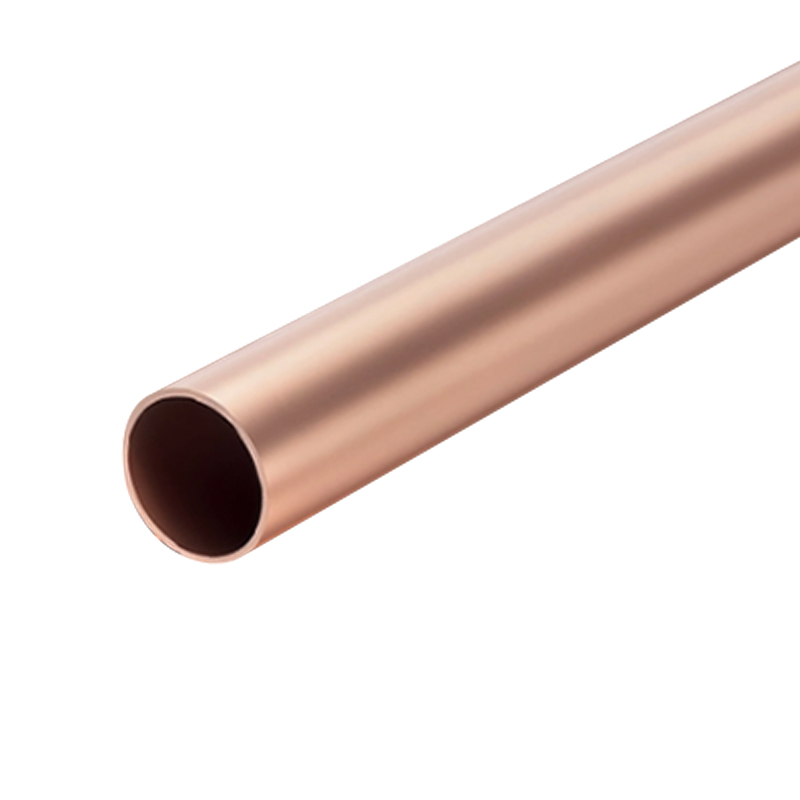
Copper Tube is made of high-purity copper material with a copper content of not less than 99.9%. The main material codes are T11050 and C12200(DHP), a...
See Details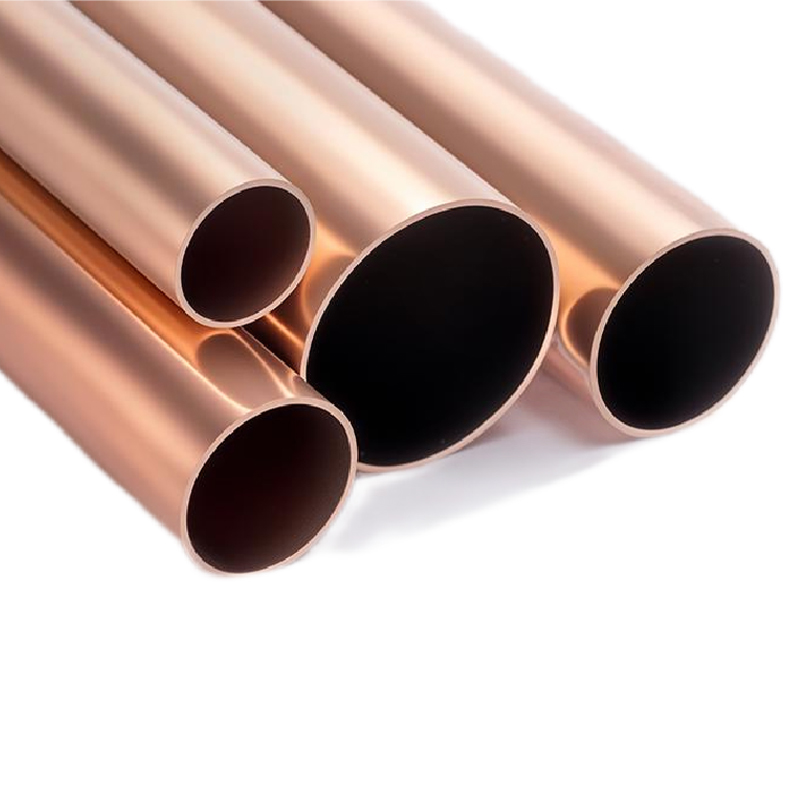
The Copper Water Tube produced by our company is a high-performance copper tube suitable for hot and cold water systems and heating applications. It h...
See Details
Copper capillary tube is usually manufactured by precision machining, and its dimensional accuracy can reach one thousandth of an inch. This ultra-hig...
See Details
The copper evaporator tube adopts a unique fin design, and the external fins are equipped with specially designed interconnected channels, so that eac...
See Details
Copper square tube is a metal tube with a hollow square cross-section. It is made of high-purity copper or copper alloy materials through multiple pre...
See Details
The condenser copper tube adopts a proprietary design independently developed by the company, and the ends of the fins are provided with radial and ax...
See Details
 Tangpu Industrial Zone, Shangyu District, Shaoxing City, Zhejiang Province, China
 +86-13567501345
© Zhejiang Jingliang Copper-Tube Products Co., Ltd All rights reserved.

