Inner grooved copper tubes outperform smooth-bore tubes in heat transfer efficiency by 20%–35%, making them the preferred choice for air conditioners, refrigeration systems, and heat exchangers worldwide. If you're sourcing from a copper tube factory, understanding the structural advantages, dimensional standards, and quality benchmarks of inner grooved tubes will directly impact your system's energy performance and lifespan.
This article covers everything from how inner grooved geometry works, to key specifications, to what separates a high-quality copper tube factory from an unreliable one.
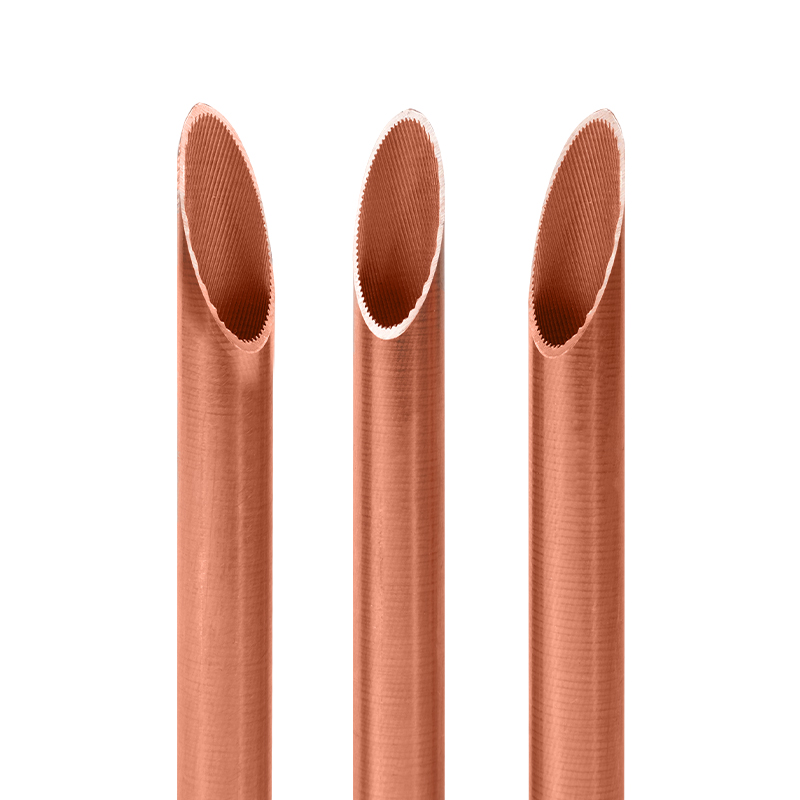
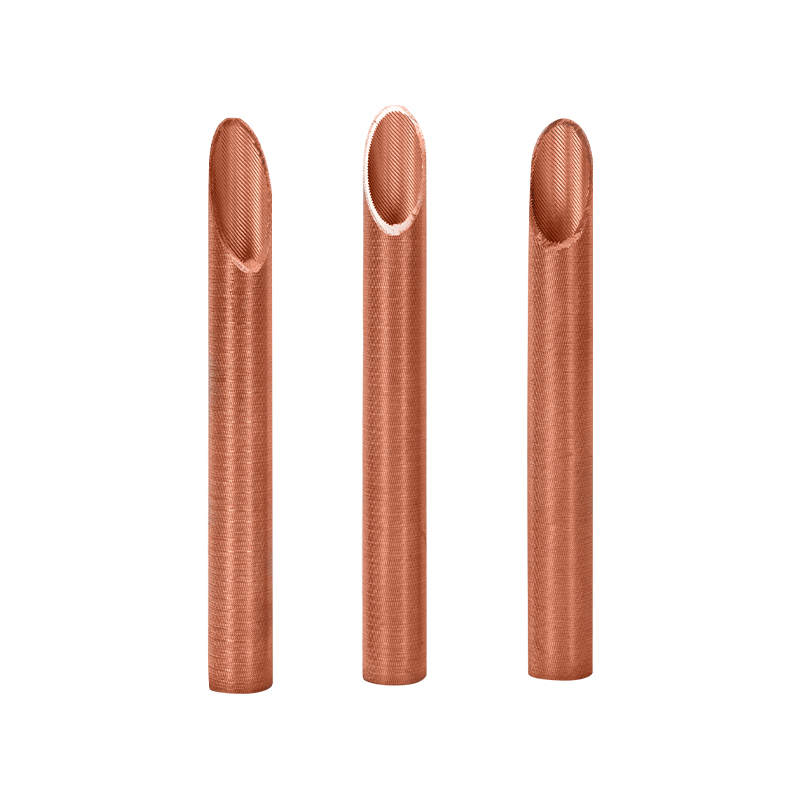
An inner grooved copper tube (also called an internally finned tube or micro-fin tube) features a series of helical fins or ridges machined or formed on the inner wall of the tube. Unlike smooth-bore tubes, this corrugated inner surface dramatically increases the effective heat transfer area and promotes turbulent fluid flow.
The grooves are typically characterized by three key parameters:
These seemingly small geometric details have a large engineering impact: a tube with 60 internal fins and a 18° helix angle can transfer heat nearly 30% more efficiently than a comparable smooth tube under the same operating conditions.
The global HVAC market relies heavily on inner grooved copper tubes because energy efficiency standards have become increasingly stringent. For example, China's GB 19577 and the EU's Ecodesign Directive both push air conditioner manufacturers toward higher SEER (Seasonal Energy Efficiency Ratio) ratings, and inner grooved tubes are a primary hardware enabler of those improvements.
When ordering from a copper tube factory, you'll encounter a dense set of dimensional and mechanical specifications. The table below summarizes the most commonly traded inner grooved tube sizes and their standard parameters:
| OD (mm) | Wall Thickness (mm) | Number of Grooves | Helix Angle (°) | Fin Height (mm) | Typical Use |
|---|---|---|---|---|---|
| 5.0 | 0.28 | 40 | 18 | 0.12 | Mini-split evaporators |
| 7.0 | 0.30 | 55 | 18 | 0.15 | Residential AC coils |
| 9.52 | 0.35 | 60 | 25 | 0.18 | Commercial HVAC, heat pumps |
| 12.7 | 0.40 | 65 | 25 | 0.20 | Industrial refrigeration |
| 15.88 | 0.50 | 75 | 30 | 0.22 | Large chiller systems |
The 9.52 mm OD tube is by far the most widely used size globally, particularly in residential split air conditioners and heat pump water heaters. Wall thickness tolerances are typically held to ±0.02 mm by reputable factories — deviations beyond this can cause premature failure under pressure cycling.
Not all copper is equal. Inner grooved tubes are almost exclusively produced from phosphorus-deoxidized copper (C12200 / TP2 grade), which contains 0.015%–0.040% phosphorus. This grade offers:
Some lower-cost suppliers substitute C11000 (electrolytic tough pitch copper), which has slightly higher oxygen content. This can cause hydrogen embrittlement if tubes are brazed improperly — a serious reliability risk in field installations. Always request a material test report (MTR) specifying the copper grade and chemical composition.
Understanding the manufacturing process helps buyers evaluate factory capability and identify potential quality gaps. The production of inner grooved copper tubes involves several tightly controlled stages:
High-purity copper cathodes (99.9%+ Cu) are melted in an induction furnace and continuously cast into billets or tubes using an upward casting method. This step determines the base material quality. Reputable factories use oxygen-free or low-oxygen casting environments to minimize inclusion defects.
The cast billet is extruded into a hollow tube, then progressively cold-drawn through a series of dies to reduce diameter and wall thickness to near-final dimensions. Intermediate annealing at 450°C–600°C restores ductility between drawing passes.
This is the core differentiating step. A grooved plug (mandrel) is inserted inside the tube while a set of three or more planetary rollers compress the tube wall onto the plug, forming the internal helical fins. The groove geometry — including fin height, helix angle, and groove width — is entirely determined by the plug design. Precision CNC-machined plugs are essential; worn or imprecise plugs produce inconsistent groove profiles that reduce heat transfer performance.
After grooving, tubes undergo a final controlled anneal to achieve the "O" (soft/annealed) or "H58" (semi-hard) temper, depending on customer requirements. Soft temper is standard for tube bending in HVAC coil fabrication; semi-hard temper is used for straight-run condenser connections.
Finished tubes are coiled (typically 15 m, 25 m, or 50 m coils) or cut to straight lengths. Final inspection includes eddy current testing for surface defects, dimensional checks with laser micrometers, and hydrostatic pressure testing at a minimum of 4.0 MPa per ASTM B743 or equivalent standards.
Sourcing from an uncertified factory carries real operational risk. Below are the key certifications and standards that distinguish professional copper tube factories:
Beyond certifications, ask factories for third-party lab test reports from accredited institutions (SGS, Intertek, Bureau Veritas) covering dimensional tolerances, tensile strength, and elongation values.
Buyers occasionally weigh whether inner grooved tubes justify their premium over smooth-bore alternatives (typically 8%–15% higher price per kg). The data consistently supports inner grooved tubes for heat exchange applications:
| Parameter | Smooth Bore Tube | Inner Grooved Tube |
|---|---|---|
| Heat transfer enhancement | Baseline (1×) | 1.2× – 1.35× |
| Pressure drop (for same duty) | Lower | 5%–10% higher |
| Refrigerant charge needed | Standard | 10%–20% less |
| Tube material cost | Lower by ~10% | Slightly higher |
| System energy savings (annual) | — | Up to 15% vs. smooth |
| Fabrication complexity (bending) | Easier | Requires care (slightly stiffer) |
For any application where energy efficiency, refrigerant cost, or system compactness matters, inner grooved tubes deliver a positive ROI within 1–2 operating seasons despite their higher upfront price.
The copper tube manufacturing industry is highly concentrated — the top 10 Chinese factories account for over 60% of global HVAC tube output. Selecting a factory requires due diligence beyond simple price comparison.
The inner grooved tube market is not static. Several technical developments are reshaping what copper tube factories produce:
Factories investing in these innovations today will hold competitive advantages as the HVAC industry transitions away from high-GWP refrigerants under the Kigali Amendment, which mandates an 80%+ reduction in HFC use by 2047 for developed nations.
If you're procuring inner grooved copper tubes at scale, the following practices will protect product quality and total cost of ownership:
Content
The inner grooved tube incorporates precision-engineered grooves or ridges along its interior surface as a specialized heat exchanger component. These...
See Details
Copper Tube is made of high-purity copper material with a copper content of not less than 99.9%. The main material codes are T11050 and C12200(DHP), a...
See Details
The Copper Water Tube produced by our company is a high-performance copper tube suitable for hot and cold water systems and heating applications. It h...
See Details
Copper capillary tube is usually manufactured by precision machining, and its dimensional accuracy can reach one thousandth of an inch. This ultra-hig...
See Details
The copper evaporator tube adopts a unique fin design, and the external fins are equipped with specially designed interconnected channels, so that eac...
See Details
Copper square tube is a metal tube with a hollow square cross-section. It is made of high-purity copper or copper alloy materials through multiple pre...
See Details