 English
 Español
 中文
News
Home / News / Industry News / how does viega propress work: Applications, Selection Criteria, and Practical Guidance
When someone asks how Viega ProPress works, they are usually holding a press fitting in one hand and a copper tube in the other, wondering whether a mechanical crimp can really replace soldering or brazing. It can, and press-connect technology has been proving itself in the field for decades. From our perspective as a copper tube manufacturer with more than thirty years in the industry, we have watched these systems become standard practice in plumbing, hydronics, and refrigeration. Understanding the mechanism not only answers the immediate question, it also helps you choose the right tubing for a reliable, long-lasting joint.
Viega ProPress is a press-connect joining system for copper tube that eliminates the need for soldering, brazing, or threaded adapters. Developed by Viega, a German manufacturer of installation technology, it is widely used in potable water, heating and cooling, and refrigeration piping.
Three components make up the system:
None of these components can do the job alone. The fitting supplies the sealing geometry, the tool supplies the force, and the tube supplies the stable surface against which the seal is made.
The working principle is simpler than it first appears. Inside the fitting body, a precisely machined groove holds the O-ring. When the installer slides the copper tube into the fitting, the tube passes over the O-ring and stops at an internal insertion stop. The pressing tool then closes around the outer surface of the fitting and applies a controlled radial force.
That force does two things. First, it compresses the fitting wall inward, squeezing the O-ring tightly against the outside surface of the copper tube and creating the watertight or gas-tight seal. Second, it cold-forms the fitting and the tube together into a mechanical interlock. The joint becomes permanent: the tube cannot be pulled out, and the connection holds working pressures comparable to a soldered joint.
Depending on the fitting size, the pressing tool delivers several tons of force in a single, uniform cycle. This consistency is a major advantage over hand-soldered joints, because the quality of the connection no longer depends on the skill of the installer.
The O-ring is not a lubricant or a wiper; it is a precision sealing component. In a correctly pressed joint, the O-ring is compressed into the confined space between the fitting and the tube, yet it keeps enough elasticity to accommodate thermal expansion and contraction. That is why press-connect systems are trusted for potable water service, hydronic heating loops, and refrigerant circuits that cycle through wide temperature swings.
Professional installers follow a consistent procedure, and tube preparation matters as much as the pressing tool itself:
A single connection takes about ten seconds from insertion to verification, compared with several minutes for a soldered joint when setup, heating, and cooling time are counted. For large projects, that difference adds up quickly.
Press fittings do not melt onto the tube; they grip it. That is why dimensional accuracy is critical. If the outer diameter is oversize, the fitting cannot close fully; if it is undersized, the O-ring will not seal. Press systems are therefore designed for copper tube produced to recognized standards.
Wall thickness is equally important. Press fittings are engineered around standard wall thicknesses, so specialty thin-wall or extra-heavy-wall tube may not be compatible unless the fitting manufacturer confirms it. For plumbing installations, we supply Type L copper pipe with the smooth surface and tight OD tolerance that press fittings rely on.
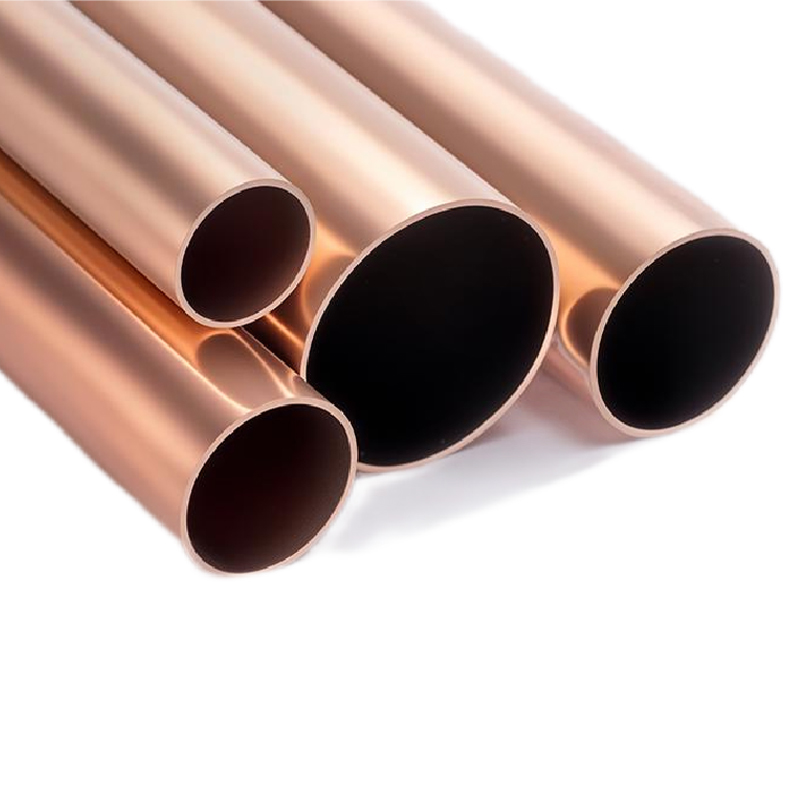 Type L Copper Water Tube for Press-Connect SystemsDesigned for hot and cold water systems, this Type L tube offers the tight tolerances and smooth surface press fittings require. Confirming dimensions ensures reliable connections.View Product →
The table below summarizes the tube types most often used with press-connect systems. In every case, the manufacturer's installation instructions specify the exact tolerance range, so it is worth confirming the tube certificate before starting a large run.
| Tube Type | Typical Application | Common Standard | Wall Characteristic |
|---|---|---|---|
| Type L copper water tube | Potable water, hydronic heating | ASTM B88 | Medium wall |
| Type M copper water tube | Potable water, light commercial | ASTM B88 | Thinner wall |
| ACR copper tube | Refrigeration, air conditioning | ASTM B280 / EN 12735 | Rated for refrigerant pressure |
As a manufacturer, we are often asked what distinguishes good copper tube for press systems. The answer comes down to four things: dimensional consistency, surface quality, correct temper, and standard compliance.
Outer diameter tolerance and roundness are the first line of defense. A tube that varies in diameter or is oval-shaped will not let the O-ring seat uniformly. That is why all of our copper tube passes through a complete in-house process, from melting and extrusion to drawing and annealing, with dimensional checks at every stage.
For refrigeration and HVAC work, press-connect fitting systems are paired with ACR tube meeting ASTM B280 or EN 12735. Clean internal surfaces and dehydrated, capped ends are essential, because the tube goes into the system without being cleaned by flux or flame. Our ASTM B280 compliant tubes are drawn and annealed in-house to keep the surface and dimensions consistent from one coil to the next.
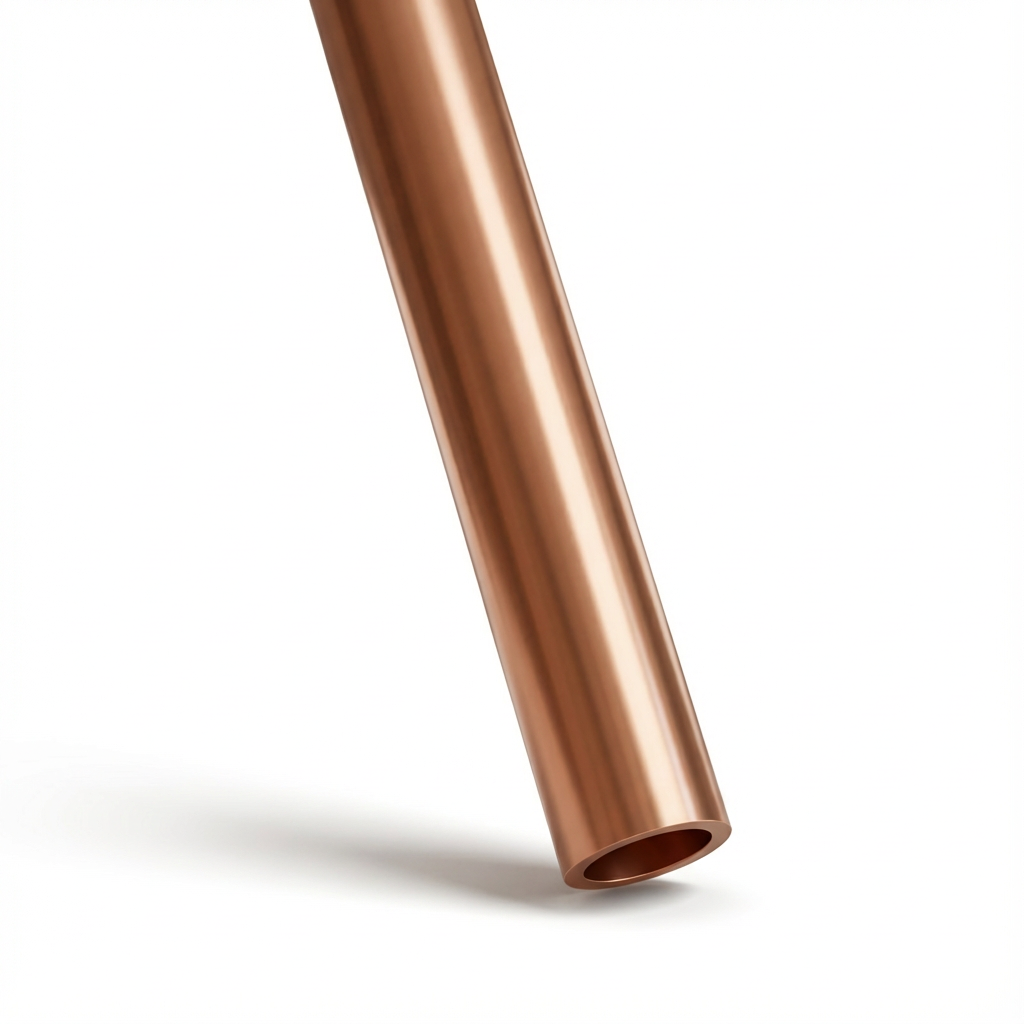 ACR Copper Tube for Press-Connect Refrigeration LinesThis ASTM B280 compliant ACR tube provides clean internal surfaces and consistent dimensions, essential for press-connect systems in HVAC and refrigeration installations without soldering.View Product →
Surface finish is another factor. Press connections depend on the O-ring gripping a clean, uniform surface, so the tube should be free of dirt, oil, and heavy oxide scale. For long runs of soft or annealed tube, a level-wound coil keeps the material straight and free of kinks, which also helps the tube slide fully into the fitting.
Viega ProPress and similar press-connect systems have made copper tube joints faster, safer, and more repeatable. The technology works because a precision fitting, a correctly rated O-ring, and a controlled pressing force combine to create a permanent mechanical connection, while the copper tube itself provides the stable surface that makes the seal possible.
If you are planning a project using press fittings, the most valuable thing you can do is verify your tube before installation: check the standard designation, the OD tolerance, and the cleanliness of the bore. A few minutes of verification at the front end saves hours of troubleshooting on the finished system. And when your tube specification calls for dependable, dimensionally consistent copper, that is exactly the kind of conversation we welcome as a manufacturing partner.
Standard refrigeration copper tube with an outer diameter of 12-28mm is made of high-quality TP2 copper (C12200/DHP), specifically designed for HVAC s...
See Details
 Tangpu Industrial Zone, Shangyu District, Shaoxing City, Zhejiang Province, China
 +86-13567501345
© Zhejiang Jingliang Copper-Tube Products Co., Ltd All rights reserved.

